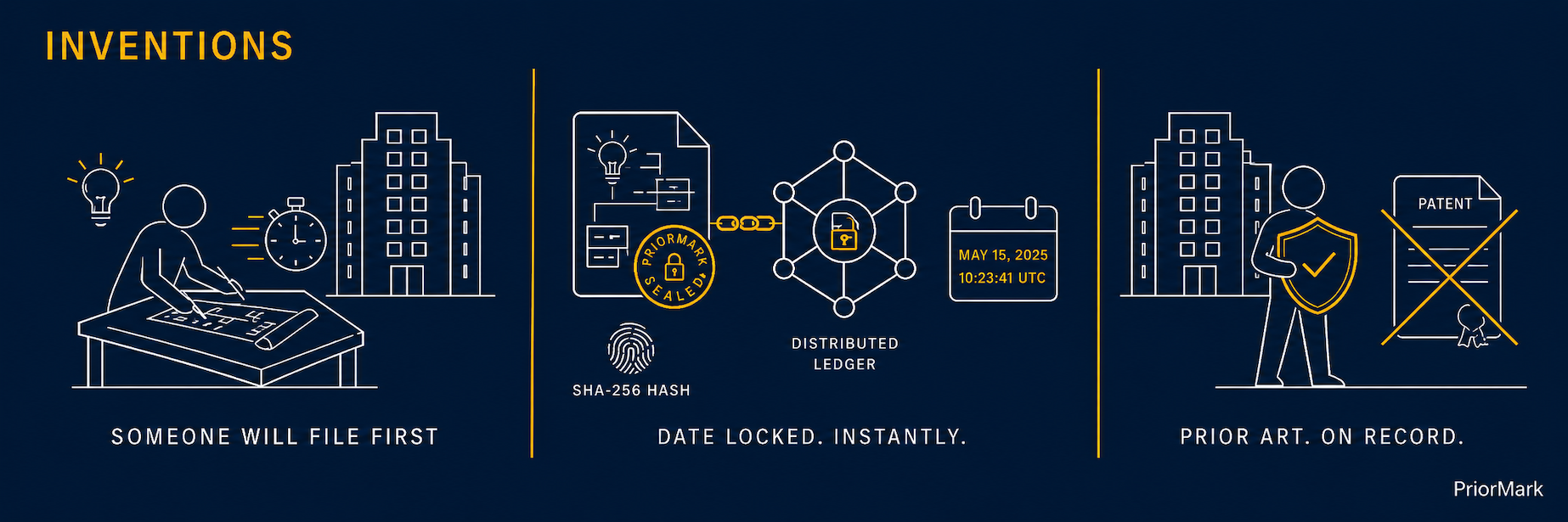
Lock in your date before you file — or before someone else does.
Establish your timestamp before you file
Not every inventor is ready to file a patent — and not every idea should be one. But that shouldn't mean losing the right to use your own work. A PriorMark timestamp documents when you developed your invention and establishes a dated record of prior use. If someone later patents similar ground, that record can protect your right to keep using what you built — and provides documented evidence to support a challenge to their claims.
A private PriorMark record doesn't constitute prior art on its own — prior art under 35 U.S.C. § 102 requires public disclosure. What it does create is a tamper-proof, independently verifiable record of when you developed your invention. That record can strengthen an invalidity challenge when combined with other evidence, and directly supports a prior commercial use defense under 35 U.S.C. § 273 if someone later asserts a patent against you.
Common scenarios
A startup is acquired. During due diligence, the acquirer wants evidence that the company's core algorithm predates a competitor's similar product. The founders produce their PriorMark records — timestamped two years earlier — and close the deal without a legal battle over IP provenance.
A mechanical engineer designs a novel joint mechanism for prosthetic limbs and timestamps the full design spec and CAD files before beginning prototype fabrication. Eight months later, a medical device company files a patent covering a nearly identical mechanism. The engineer's PriorMark record — predating the filing by seven months — constitutes prior art under 35 U.S.C. § 102(a)(1) and provides the foundation for an invalidity challenge, without requiring the inventor to have filed anything.
An independent inventor develops a new battery cell configuration in a home workshop and timestamps the technical drawings and test results before showing the design to any manufacturer or investor. Unsure whether to pursue a patent, they establish the timestamp now to preserve their options. Two years later, when a larger company begins commercializing a similar design, the inventor has a dated record predating any known public disclosure — giving them documented grounds to raise prior art and negotiate rather than litigate from scratch.
Real Cases — when the proof wasn't there
These cases turned on the ability to prove prior development with a verifiable, dated record. A forensic timestamp wouldn't guarantee a different verdict — but it would have changed the evidentiary foundation entirely.
NTP, a patent holding company, sued BlackBerry maker RIM for infringing patents related to wireless email delivery. RIM's defense centered on prior art — arguing that similar technology had been developed before NTP's patents were filed. Despite widespread belief in the engineering community that wireless email concepts predated NTP's filings, documented prior art was insufficient to invalidate the patents. RIM settled for $612.5 million. Several independent inventors who had developed similar systems years earlier had no verifiable record capable of supporting a challenge.
Had they used PriorMark
A public ledger record of a working wireless email architecture predating NTP's patent filings would have constituted prior art under 35 U.S.C. § 102(a)(1) — potentially invalidating the patents entirely and saving RIM over $600 million. The technology existed. The proof didn't.
Gary Kildall developed CP/M, one of the first widely-used personal computer operating systems. When IBM approached him to license it for the IBM PC, negotiations stalled. IBM went to Bill Gates, who licensed QDOS — a system widely believed to be derived from CP/M — which became MS-DOS and the foundation of Microsoft's dominance. Kildall believed his IP had been taken and the industry largely agreed, but he was never able to successfully enforce his prior conception claim in a way that held up legally. He died in 1994 without resolution.
Had they used PriorMark
A timestamped ledger record of CP/M's development — the architecture, source code, and design specifications — would have created independently verifiable prior art predating MS-DOS by years. It wouldn't have guaranteed a legal win, but it would have given him a documented, tamper-proof foundation from which to assert his claim rather than relying on the industry's collective memory.
How PriorMark helps
Priority before you decide
File or don't — either way, your development date is locked. Optionality is valuable, especially early stage.
Prior art on demand
A public ledger record predating a competitor's patent application is admissible prior art in US, EU, and Chinese patent proceedings.
Due diligence ready
Timestamped records make IP ownership conversations with acquirers, investors, and partners significantly cleaner.
See Inventors pricing options.
Two simple tiers. One-time fee. No hidden charges.
Nothing on this page constitutes legal advice. A PriorMark forensic timestamp is evidence of prior possession — how it applies to your specific situation, dispute, or legal proceeding is a question for a licensed attorney. See legal context →